1.2. Heat Transfer in Composite Walls
The image below shows an example of a composite wall used for heat transfer simulation:
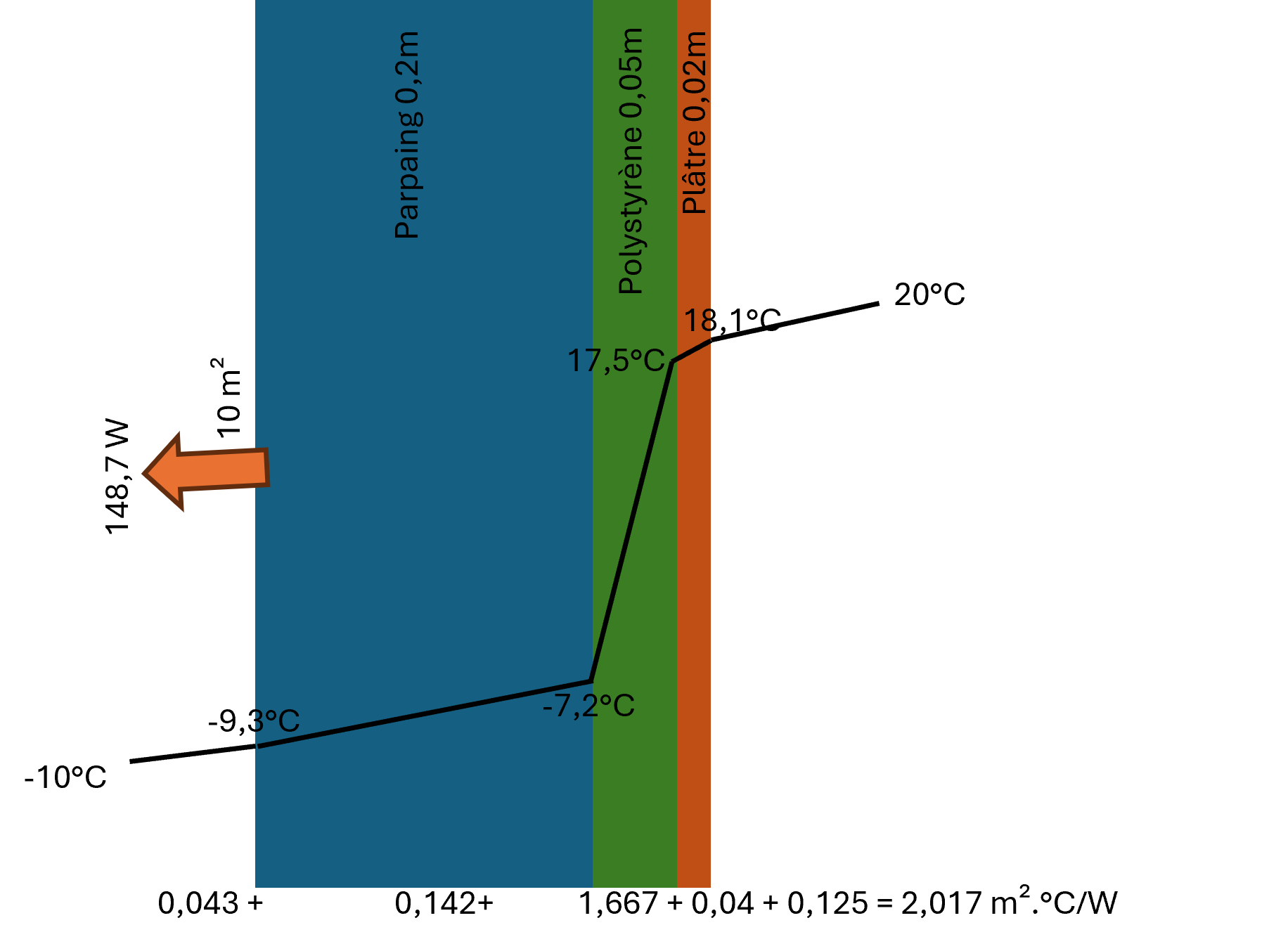
Example of heat transfer simulation in a composite wall:
from HeatTransfer import CompositeWall

# Create a composite wall with external and internal convection coefficients
wall = CompositeWall.Object(he=23, hi=8, Ti=20, Te=-10, A=10)

# Add layers to the wall using material names
wall.add_layer(thickness=0.20, material='Parpaings creux')  # Hollow concrete blocks
wall.add_layer(thickness=0.05, material='Polystyrène')  # Polystyrene
wall.add_layer(thickness=0.02, material='Plâtre')  # Plaster

# Calculate heat transfer and temperatures at each layer interface
wall.calculate()
wall.df
print(f"df = {wall.df}")
print(f"R_total = {wall.R_total} m².°C/W")
Expected result:
Thickness (m) |
Material |
Conductivity (W/m.°C) |
Resistance (m².°C/W) |
Entry Temperature (°C) |
Exit Temperature (°C) |
Q (W) |
A (m²) |
|---|---|---|---|---|---|---|---|
NaN |
Outdoor air |
NaN |
0.043478 |
-10.000000 |
-9.353644 |
148.661889 |
10 |
0.20 |
Hollow concrete blocks |
1.40 |
0.142857 |
-9.353644 |
-7.229903 |
148.661889 |
10 |
0.05 |
Polystyrene |
0.03 |
1.666667 |
-7.229903 |
17.547079 |
148.661889 |
10 |
0.02 |
Plaster |
0.50 |
0.040000 |
17.547079 |
18.141726 |
148.661889 |
10 |
NaN |
Indoor air |
NaN |
0.125000 |
18.141726 |
20.000000 |
148.661889 |
10 |
List of Available Materials
Anglais |
Français |
Conductivité thermique (W/m.°C) |
|---|---|---|
Glass wool |
Laine de verre |
0.034 |
Expanded cork agglomerated with pitch |
Liège expansé aggloméré au brai |
0.048 |
Pure expanded cork |
Liège expansé pur |
0.043 |
Hollow concrete blocks |
Parpaings creux |
1.4 |
Hard limestone (marble) |
Pierre calcaire dure (marbre) |
2.9 |
Soft limestone |
Pierre calcaire tendre |
0.95 |
Granite |
Pierre granit |
3.5 |
Expanded polystyrene |
Polystyrène expansé |
0.047 |
Polystyrene |
Polystyrène |
0.03 |
Extruded polystyrene |
Polystyrène extrudé |
0.035 |
Polyurethane foam |
Mousse de polyuréthane |
0.03 |
Plaster |
Plâtre |
0.5 |
Glass |
Verre |
1.0 |
Air |
Air |
None |
Explanation of the Equations Used
The composite wall heat transfer model uses the following equations to calculate total thermal resistance, heat flux, and temperatures at layer interfaces:
Convective thermal resistance: - External resistance:
\[R_e = \frac{1}{h_e}\]Internal resistance: .. math:
R_i = \frac{1}{h_i}
Thermal resistance of layers: - For each layer, thermal resistance is calculated as follows:
\[R_{\text{layer}} = \frac{\text{thickness}}{\text{conductivity}}\]Total thermal resistance: - The total thermal resistance of the composite wall is the sum of convective resistances and layer resistances:
\[R_{\text{total}} = R_e + R_i + \sum R_{\text{layers}}\]Heat transfer coefficient: - The heat transfer coefficient is the inverse of total thermal resistance:
\[U = \frac{1}{R_{\text{total}}}\]Heat flux: - Heat flux through the composite wall is calculated using Fourier’s law:
\[Q = U \cdot A \cdot (T_i - T_e)\]where ( A ) is the wall surface area, ( T_i ) is the indoor temperature, and ( T_e ) is the outdoor temperature.
Temperatures at layer interfaces: - The external wall temperature after convective resistance is calculated as follows:
\[T_{\text{external wall}} = T_e + \frac{Q \cdot R_e}{A}\]Les températures aux interfaces des couches sont ensuite calculées en utilisant le flux thermique et les résistances thermiques : .. math:
T_{\text{interface}} = T_{\text{précédente}} + \frac{Q \cdot R_{\text{couche}}}{A}
Ces équations permettent de déterminer la distribution de température à travers le mur composite et le flux thermique total traversant le mur.